
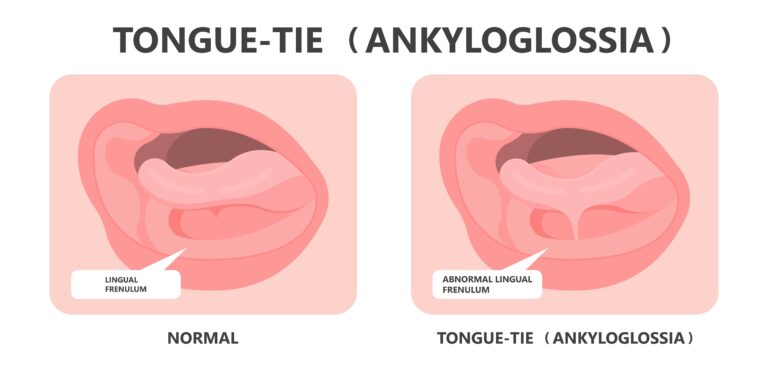
A tiny band of tissue may not seem like much of a problem. But when the frenulum connecting the tongue to the floor of the mouth, or the lip to the gums, is too tight or too short, its impact on feeding, breathing, dental health, and sleep can compound quietly over months and years. Many parents are reassured that their child will grow out of a tongue or lip tie. In some cases, functional difficulties do lessen. In many others, the downstream consequences of leaving these restrictions untreated become more difficult to address the longer they are left in place.
At Airway Dental and More, we evaluate and treat tongue and lip ties in patients of all ages, from infants experiencing feeding challenges to adults who have carried the effects of an undiagnosed restriction for years. Dr. Neil Stevenson approaches these cases with both the clinical precision and broader airway-focused perspective that allows us to understand the full picture of how oral restrictions affect your health.
What These Conditions Are
Tongue tie, or ankyloglossia, occurs when the band of tissue connecting the underside of the tongue to the floor of the mouth is too short or too tight, limiting the tongue’s range of movement. Lip tie refers to an overly tight or restrictive frenulum connecting the upper or lower lip to the gums. Both conditions can be present at birth, and both can interfere with feeding, oral development, and proper oral rest posture in ways that are not always immediately visible.
According to a StatPearls review published by the National Institutes of Health, ankyloglossia has been linked to breastfeeding difficulties, malocclusion, and gingival recession and remains an area of active clinical discussion regarding when and how to treat it. What is clear is that untreated cases do not simply resolve without consequence for many patients.
Feeding and Nutritional Consequences
The earliest and most recognizable effects are feeding-related. In infants, tongue restriction impairs the seal and suction mechanics needed for effective breastfeeding. Feeding sessions become longer and less efficient, weight gain may lag, and both infant and mother may experience significant discomfort. As children grow, these difficulties can evolve into aversions to certain food textures, slower eating, more frequent gagging, and a preference for soft foods that require minimal tongue manipulation.
These patterns are not simply picky eating. They reflect genuine motor limitations that affect how food is moved around the mouth and managed during chewing and swallowing, and they do not resolve on their own once the habit has formed.
Dental and Gum Health
Tongue tie has a direct effect on oral hygiene and periodontal health. A tongue that cannot move freely cannot sweep food debris away from teeth and gums as it would naturally. It may also pull abnormally on gum tissue, particularly along the lower front teeth, contributing to gingival recession over time. Restrictions in lip mobility from lip ties can trap food and plaque along the gum margin of the upper front teeth, increasing cavity risk in an area that is otherwise difficult to clean.
When the tongue cannot rest in its natural position against the roof of the mouth, the pressure balance between tongue and cheek muscles that guides jaw and arch development is disrupted. This can contribute to a high-arched palate, a narrowed arch, and malocclusions that may later require orthodontic treatment.
Airway and Sleep
Proper tongue posture is fundamental to keeping the airway open, particularly during sleep. When the tongue rests on the floor of the mouth rather than against the palate due to restriction, it can partially obstruct the upper airway. Children and adults with untreated ties may experience chronic mouth breathing, snoring, restless sleep, and fatigue despite adequate hours of rest. These patterns affect immune function, mood, concentration, and growth hormone regulation in ways that reach far beyond any dental concern alone.
We address tongue and lip tie treatment as part of a comprehensive view of airway health that includes evaluating how oral restrictions interact with breathing, sleep, and facial development. Our myofunctional therapy program supports retraining of the oral muscles following a frenectomy to ensure the tongue learns to function properly in its restored range of motion.
Airway Dental and More | Jacksonville, FL
Dr. Stevenson earned his Doctor of Medical Dentistry from the University of Florida College of Dentistry and takes a whole-health approach to tongue and lip tie evaluation and treatment. We use advanced laser technology to perform frenectomy procedures with precision, minimal discomfort, and faster healing times than conventional methods. Our team provides detailed post-procedure care guidance and follow-up support to ensure lasting results.
If you suspect that you or your child may have an untreated tongue or lip tie, early evaluation gives you the clearest path forward. Contact Airway Dental and More online or call our Jacksonville office to schedule a consultation with Dr. Stevenson.